Skip to Content

Interdisciplinary Science and Research Program

Academy of Nashville at Stratford and Hillsboro

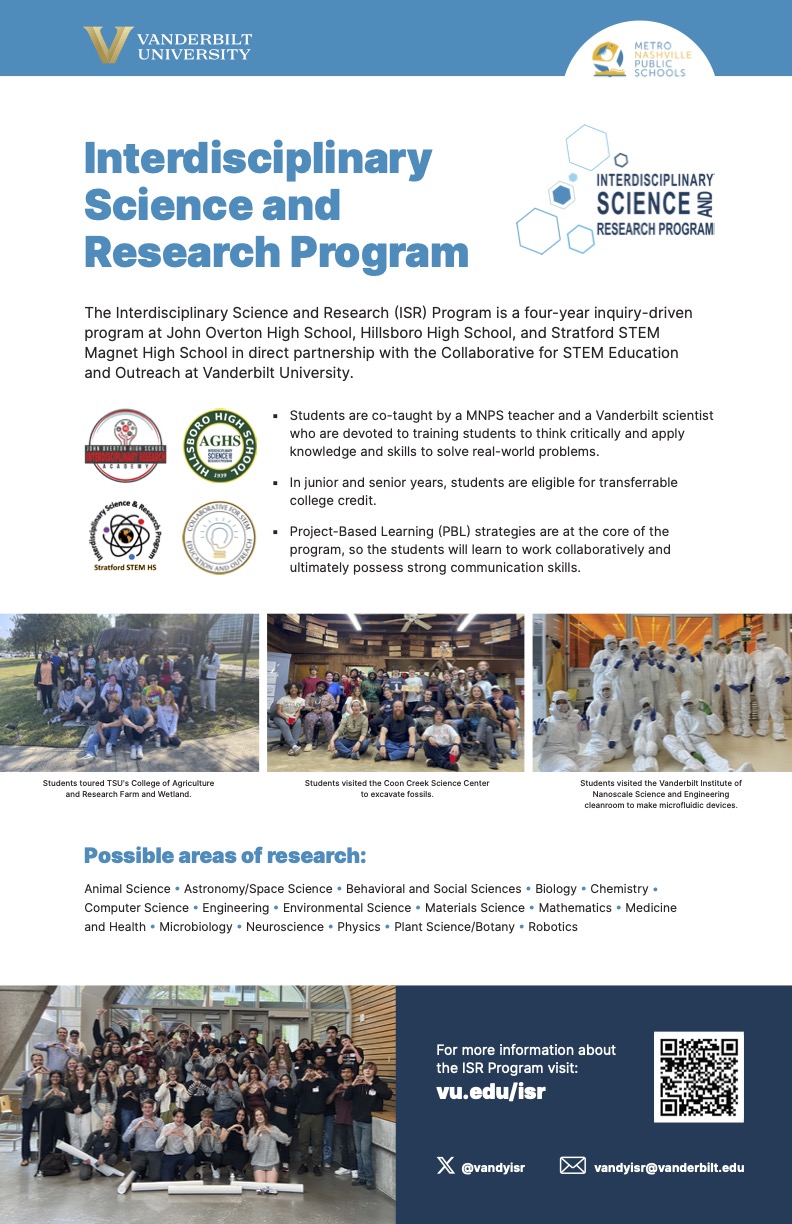
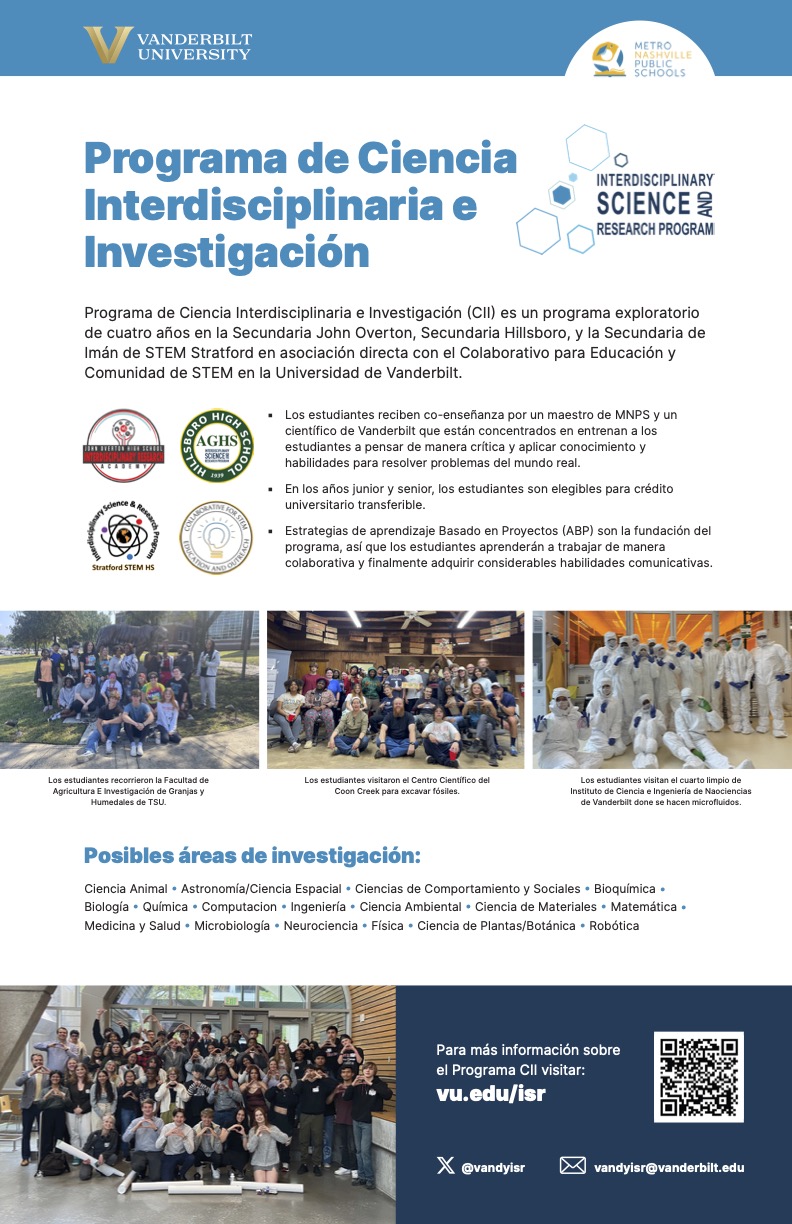
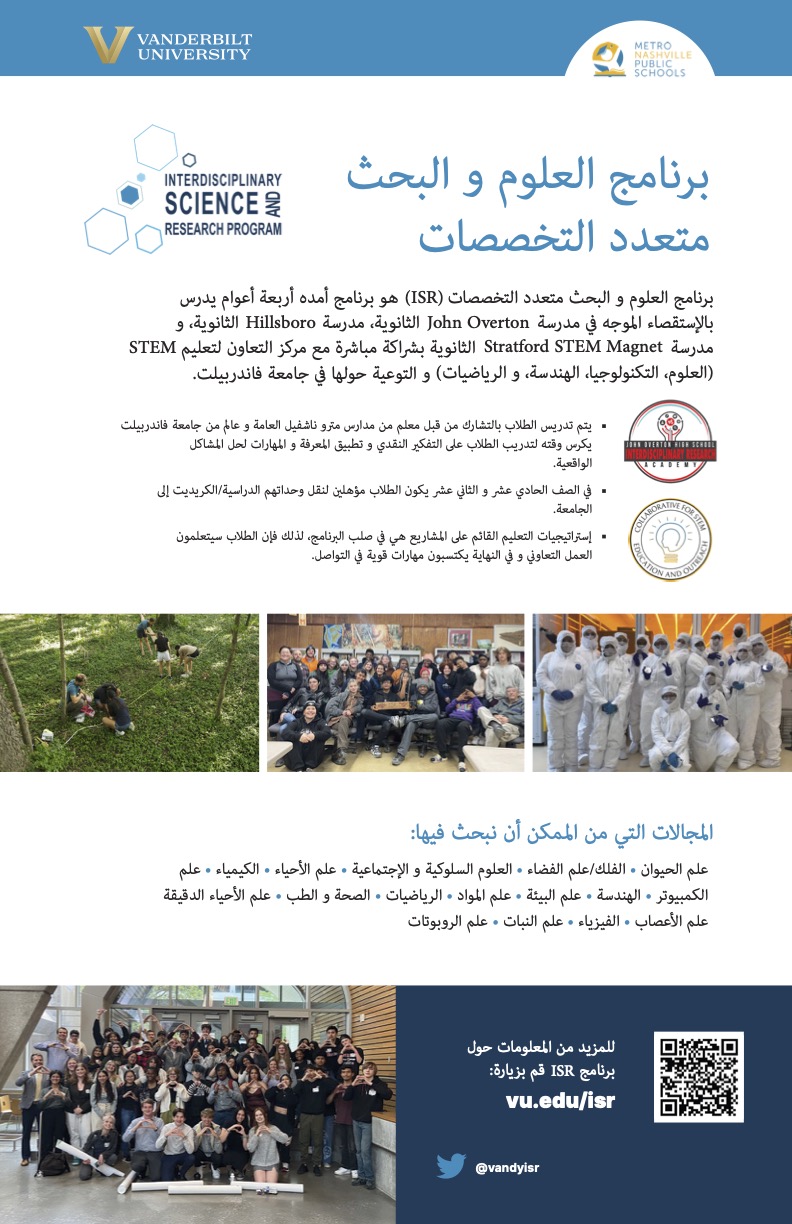
The Interdisciplinary Science and Research (ISR) Program is a partnership between the Vanderbilt Center for Science Outreach and Metropolitan Nashville Public Schools to enhance the understanding of STEM concepts and research principles of students and empowering teachers through scientific research. All courses are co-taught by a scientist-teacher team and focus on individualizing instruction to meet student needs.The program transitions students from basic understanding of scientific disciplines in the first year, to independent research in the junior and senior year. The Interdisciplinary Science and Research Program is elevating the learning and teaching of science, leading to students who are prepared to solve 21st century problems.

This project was supported by the National Center for Research Resources and the Division of Program Coordination, Planning, and Strategic Initiatives of the National Institutes of Health through Grant Number R25 OD011119.

Applying

Students who wish to participate in the ISR programs at Stratford or Hillsboro must apply with the appropriate form below to be considered for admission to the program.

The admission process is handled entirely by the individual schools, so applications must be returned to the address on the forms and not to the Center for Science Outreach.

Hillsboro High School's Academy of Global Health and Science

Stratford High School's Academy of Science and Engineering

* Please note, the due dates on the forms have not been updated, however, the forms will be accepted through the beginning of the school year.

Course Descriptions

Interdisciplinary Science I - 9th Grade

Through a unique interdisciplinary curriculum, students explore the scientific connections between physical, chemical, and biological systems. Project-based themes weave together the study of energy, change over time, structure/function, sustainability, global health, and the nature of the universe. Students develop an understanding of the fundamental concepts essential to scientific inquiry. Each primary lesson incorporates classroom work, intensive laboratories, and associated enrichment activities. Students are expected to be active, collaborative learners who will engage in the process of science: formulating questions, developing and testing hypotheses, and presenting results. Throughout the course, students will connect the history of scientific discovery with current, ongoing research.

Interdisciplinary Science II - 10th Grade

Students further their research skills taught in Interdisciplinary Science I for formulating scientific inquiry. In this accelerated, multidisciplinary course, students investigate research questions under four major themes during each nine-week period. Students learn the scientific concepts required for understanding of the research projects in Research I. The students learn chemical, biological, physical, and environmental concepts necessary for studying water quality in the first unit, forensic science concepts in the second nine-week unit, archaeological topics in the third unit, and global health in the fourth unit. Students learn how to ask testable questions and relate that to their research in Research I. The interdisciplinary questions are examined based on the physical, chemical, and biological basis of the problem. Individual research questions are explored through readings, discussions, and presentations by scientists. The team-taught curriculum consists of core lessons which explain current knowledge and theories applicable to their physical, chemical, and biological bases, advanced laboratories emphasizing team building, peer teaching of current events and virtual international student roundtable discussions. 

Research I - 10th Grade

This introductory Research I course is based on Interdisciplinary Science II content with emphasis on hands-on use of research tools across disciplines. Students are introduced to all aspects of research with particular emphasis on experimental design, statistics, ethics, writing and communication. Methodologies for observation, data collection, and analysis are explored in greater depth with a focus on cross-discipline application. Students form teams to investigate a question of interest for each 9-week project, integrating learned research tools and techniques. Project questions are developed by the teams with faculty advisement. Teams present the results of their projects in a seminar format at the conclusion of each project unit.

Interdisciplinary Science III - 11th Grade

In the third course in the interdisciplinary science sequence students learn complex scientific concepts through the study of semester-long project and research-based units covering environmental science and global health. The course is taken concurrently with Honors Research II (below) and focuses on conducting long-term environmental science and global health research projects of the students’ design. The course material is integrated with faculty discussions, group projects, site visits to laboratories, and field work for research projects. This course prepares students for a summer research internship in the summer following the 11th grade year. 

Research II - 11th Grade

Students are paired with Vanderbilt scientists to explore potential research projects conducted during the 11th grade academic year. This research will contribute to the overall understanding of important scientific questions focusing on environmental science and global health as identified by top scientists world-wide. Students work through all aspects of the scientific method to design, test and verify their results. They present their findings in a community forum through oral and poster presentations. The course builds on critical thinking and communication skills from IS-I-II and emphasizes real-world science applications.

Research III - Summer Following 11th Grade

This research course for rising 12th grade students begins with an intensive six-week summer internship with a Vanderbilt faculty mentor in which students will complete individual research projects. These projects will focus on the proposals students complete during IS-III. During this internship, students will work full time in the laboratory to perform all aspects of research, maintain a research journal, and participate in breakout sessions led by a team of Vanderbilt faculty, post-doctoral researchers, and graduate students. The purpose of these breakout sessions is to complement the student's lab experience by developing skill sets for scientific communication and comprehension and to expose students to the scientific research community, scientific careers, and university studies. Research findings will be communicated in an end-of-summer poster session for all students as well as senior year national science competition entries and manuscript submissions for journal publication.

Interdisciplinary Science IV - 12th Grade

In the last class in the pathway, students continue and complete their research projects and communicate outcomes. Students prepare and submit their projects to one or more national science competitions (Intel Science Talent, Siemens/Westinghouse, etc.) as well as submit a manuscript for submission to an in-house research journal and potentially for national publication. A focus in this course will be on refining oral and written communication skills, both to the scientific community as well as to the public. Students also continue to learn valuable skills in complex scientific concepts focusing on interdisciplinary themes.